Last updated: August 16, 2026
Not every well needs a carbon filter, but for households dealing with a chlorine taste, a musty smell, or certain organic contaminants, an activated carbon water filter is often the piece of equipment that actually solves the complaint. The tricky part is knowing when carbon is the right tool and when it is being asked to do a job it was never built for.
This guide covers how carbon filtration works, what it does and does not remove, and how it fits alongside sediment filtration in a well water system. It leans on manufacturer certification and EPA guidance rather than marketing claims, since carbon filters vary widely in what they are actually tested and rated to reduce.
Quick Answer
Do you need a carbon filter for well water?
- If your complaint is taste, odor, or a chlorine smell, a carbon filter is generally the right category of equipment to look at.
- If your water test shows sediment, hardness, or bacteria, carbon filtration alone will not address those; you need a different or additional stage.
- For any contaminant with a health basis, only rely on a carbon filter certified for that specific substance, and confirm the certification directly with the manufacturer.
When a Carbon Filter Is and Is Not the Answer
Use this table to check whether carbon filtration is likely to address your specific well water complaint before you shop.
| Complaint | Is carbon filtration likely to help? | Notes |
|---|---|---|
| Chlorine taste or smell | Yes | One of the core uses of activated carbon media |
| Musty or earthy taste | Often | Carbon commonly addresses organic compounds behind these tastes |
| Sulfur or rotten egg odor | Sometimes, for milder cases | Carbon can lose effectiveness as concentration rises; see our sulfur odor guide |
| Sand, silt, or grit | No | That is the job of a sediment filter, not carbon |
| Hardness or scale buildup | No | Carbon does not soften water; that requires a water softener |
| Specific health-related contaminants (PFAS, certain VOCs) | Only if certified for that exact substance | Check NSF/ANSI 42 or 53 listing for the specific contaminant, not general marketing claims |
How Activated Carbon Filtration Works
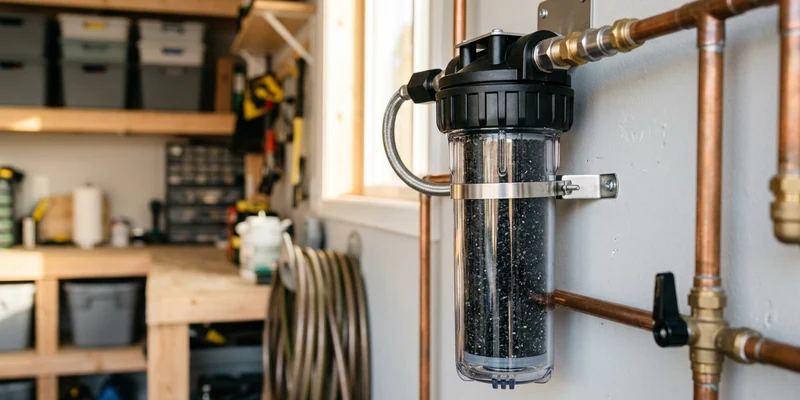
Activated carbon media has an extremely porous surface that adsorbs certain molecules as water passes through it, pulling out chlorine, some organic compounds, and the substances responsible for many taste and odor complaints. This is a different mechanism than a sediment filter, which physically strains out particles rather than adsorbing dissolved substances, which is why the two are often confused despite doing very different jobs.
Carbon filters come in a few physical formats, including granular activated carbon and carbon block cartridges, and the format affects both flow rate and how finely the media can also catch some particulate along the way. Manufacturer specifications, not the general category name, determine what a specific carbon filter is actually rated to do.
Granular Carbon vs. Carbon Block
Granular activated carbon fills a cartridge with loose carbon particles, which generally allows higher flow rates and lower resistance, making it a common choice for whole house systems that need to keep up with household demand. Carbon block cartridges compress carbon into a solid form, which tends to increase contact time between the water and the media and can improve reduction of certain substances, though usually at a somewhat lower flow rate than a comparable granular cartridge.
Neither format is universally better; the right choice depends on your household’s flow rate needs and what the manufacturer has specifically tested and certified that cartridge to reduce. An activated carbon water filter sold as a whole house unit will generally specify which format it uses in the product documentation.

What a Carbon Filter Certification Actually Covers
NSF/ANSI 42 covers aesthetic effects, meaning taste, odor, and chlorine reduction, while NSF/ANSI 53 covers specific contaminants with a known or suspected health effect. A carbon filter certified to one does not automatically cover the other, and certification under either standard is granular: a product is tested and listed for particular substances, not for contaminant reduction in the abstract.
Granular activated carbon is one of the household filter types EPA guidance has identified as capable of reducing PFAS, but that capability still needs to be confirmed for the specific product through its NSF/ANSI 53 or 58 listing rather than assumed from the carbon category generally. Verify any specific contaminant claim against the manufacturer’s current certification listing, since filter media and tested contaminants can change between product revisions.
Carbon Filter vs. Sediment Filter: Different Jobs
The carbon filter vs sediment filter comparison comes up often because both are common early stages in a well water system, but they are not interchangeable. A sediment filter is a physical strainer targeting particles; a carbon filter is an adsorption media targeting dissolved substances like chlorine and certain organics. Most whole-house systems use both in sequence, sediment first to protect the carbon stage from clogging prematurely.
Running carbon media without a sediment pre-filter ahead of it, especially on well water with any grit or turbidity, tends to shorten the carbon cartridge’s usable life considerably. Our water filter types guide covers how sediment, carbon, and other stages typically layer together.
Carbon and Sulfur Odor: A Partial Fix
Activated carbon filtration can absorb hydrogen sulfide at lower concentrations, which is why it shows up as one option for treating well water that smells like sulfur. It tends to lose effectiveness as concentration rises, though, and needs more frequent cartridge changes to keep performing when it is handling odor rather than just chlorine taste.
For stronger or more persistent sulfur odor, oxidation-based approaches like aeration or chlorination followed by filtration are generally more established as a whole-house fix. Our sulfur smell guide covers the full range of causes and treatment options for that specific complaint.
Common Mistakes to Avoid
- Buying a carbon filter for sediment or hardness. Carbon adsorbs dissolved substances; it does not strain particles or soften water.
- Assuming any carbon filter removes PFAS or other health-related contaminants. Only rely on a product specifically certified for that substance.
- Skipping the sediment pre-filter. Unfiltered particles shorten carbon media life and reduce flow faster than expected.
- Using carbon alone for strong sulfur odor. Carbon has limits with higher concentrations; whole-house oxidation approaches are usually more reliable there.
- Ignoring cartridge replacement schedules. Spent carbon media stops adsorbing effectively well before it looks visibly dirty.
Frequently Asked Questions
What does a carbon filter for well water actually remove? Primarily chlorine taste and odor, along with certain organic compounds, depending on the specific product’s certification. Health-related contaminants are only covered if the product is specifically certified for that exact substance.
Is an activated carbon water filter the same as a whole house filter? Not exactly. Activated carbon is one type of media used inside a whole house filtration system, which often also includes a sediment stage. A whole house filter can combine carbon with other stages in a single unit.
Does a carbon filter remove hardness from well water? No. Hardness minerals like calcium and magnesium require a water softener using ion exchange, which is a completely different process from carbon adsorption.
How long does a carbon filter cartridge typically last? It depends on your water quality and usage, following the manufacturer’s stated rating for that specific cartridge. Check the manufacturer’s guidance rather than assuming a fixed number of months applies universally.
Can a carbon filter remove bacteria from well water? No, and it should never be relied on for that purpose. Bacteria concerns require testing through a certified laboratory and a treatment method specifically suited for microbial contamination.
Should I install a carbon filter before or after a sediment filter? After. Sediment filtration is standard practice as the first stage, protecting the carbon media from particles that would otherwise clog it and shorten its usable life.
The Bottom Line
A carbon filter for well water is the right tool for chlorine taste, odor, and certain certified contaminants, but it is not a substitute for sediment filtration, water softening, or bacteria treatment. Activated carbon adsorbs dissolved substances rather than straining particles, which is why it is almost always paired with a sediment pre-filter in a real setup. Check the specific NSF/ANSI certification for any contaminant claim that matters to your household, and confirm it against the manufacturer’s current listing rather than the box copy alone.
See when carbon filtration helps