Last updated: August 16, 2026
Search for a well water fix and you will run into a wall of overlapping terms: sediment filters, carbon filters, reverse osmosis, water softeners, UV systems. Understanding the types of water filters available, and just as importantly what each one does not do, is the difference between solving your actual problem and buying equipment that never touches it.
This guide breaks down the main categories of water filtration systems, what each stage targets, and how they typically stack together in a real well water setup. It is meant as a map before you shop, not a buying guide on its own, so it links out to the deeper equipment guides for each type along the way.
Quick Answer
What are the main types of water filters for well water?
- Sediment filters catch particles like sand, silt, and rust, and are usually the first stage in any well water system.
- Carbon filters address taste, odor, and chlorine, and some are certified for specific contaminants like PFAS.
- Reverse osmosis adds a much finer membrane stage, typically at a single tap, for the highest level of reduction available at the point of use.
- Water softeners are a separate category entirely; they treat hardness minerals through ion exchange, not filtration.
Water Filter Types at a Glance
Each type of water filtration system is built to solve a different problem, and most well water setups end up combining more than one. Use this table to see where each category fits before reading the detail sections below.
| Filter type | What it targets | What it typically does not do |
|---|---|---|
| Sediment filter | Sand, silt, rust, and other suspended particles | Dissolved contaminants, taste, or odor |
| Carbon filter | Chlorine taste and odor; some models are certified for specific organic contaminants | Dissolved minerals, hardness, or most heavy metals |
| Reverse osmosis | A broad range of dissolved solids at a fine membrane level, typically at one tap | Whole-house treatment; RO is usually a point-of-use system, not point-of-entry |
| Water softener | Hardness minerals, calcium and magnesium, through ion exchange | Sediment, taste, odor, or contaminant reduction |
| UV disinfection | Bacteria and other microorganisms passing through the light | Sediment or dissolved contaminants; needs clean, pre-filtered water to work |
Not sure which of these your water actually needs? Our well water testing guide covers what to test for before you choose any type of water filter.
Sediment Filtration: The First Stage in Most Setups
Sediment filters remove suspended particles like sand, silt, clay, and rust flakes by physically straining water through a media cartridge. In a well water system, a sediment stage is usually installed first, ahead of any carbon or reverse osmosis equipment, since it protects those finer stages from clogging prematurely.
Sediment filters are rated by micron size, a measurement of the smallest particle the filter can capture, but the exact rating you need depends on your specific water and equipment. Our sediment filter guide covers how micron ratings work and how to choose one for a well water setup.
Carbon Filtration: Taste, Odor, and Select Contaminants
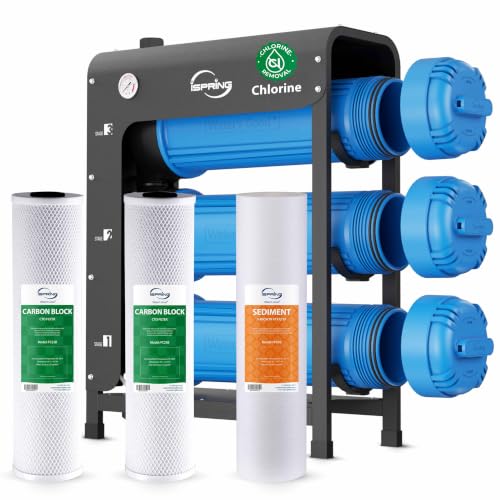
Carbon filters use activated carbon media to adsorb chlorine, certain organic compounds, and the substances responsible for taste and odor complaints. Some carbon filters carry a certification, such as NSF/ANSI 42 for aesthetic effects or NSF/ANSI 53 for specific health-related contaminants, but that certification only applies to what is explicitly listed for that product.
Not every well needs a carbon stage; it depends on what your water test actually finds. Our carbon filter guide covers when a carbon stage is worth adding and what it can and cannot be expected to do.
Reverse Osmosis: The Finest Level of Point-of-Use Filtration
Reverse osmosis pushes water through a semi-permeable membrane fine enough to reduce a broad range of dissolved solids, well beyond what sediment or carbon stages reach on their own. Systems certified to NSF/ANSI 58 have been evaluated for both contaminant reduction performance and material safety as a complete drinking water system.
Reverse osmosis is almost always installed as a point-of-use system, most commonly under the kitchen sink, rather than treating every tap in the house. Our reverse osmosis system guide covers how to choose one, and our RO installation guide walks through what setup actually involves.
Where Water Softeners and UV Fit In
A water softener is not technically a water filtration system at all. It uses ion exchange resin to swap hardness minerals, calcium and magnesium, for sodium or potassium ions, which addresses scale buildup rather than removing particles or contaminants. Many well households run a softener alongside a separate filtration setup, since the two solve entirely different problems.
UV disinfection systems use ultraviolet light to target bacteria and other microorganisms, but they depend on clean water reaching the UV chamber. A sediment stage ahead of any UV unit is standard practice, since cloudy or particle-laden water can shield organisms from the light and reduce how well the system performs.
How These Types of Water Filtration Systems Work Together
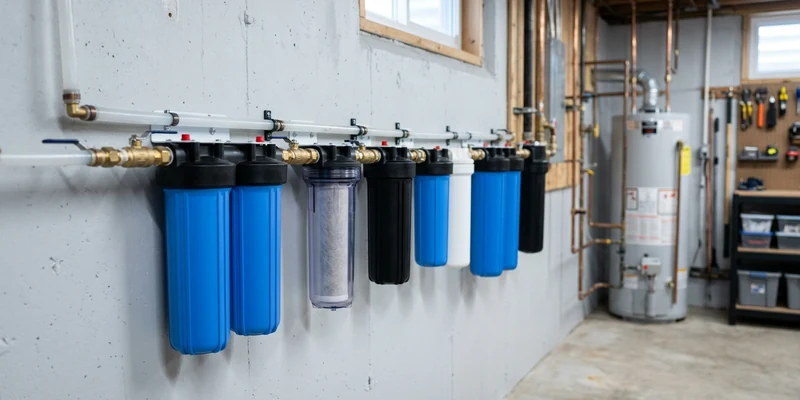
A typical well water filtration system layers more than one type in sequence: sediment first to protect downstream equipment, then carbon for taste and odor, then optionally a softener for hardness and reverse osmosis at the kitchen tap for drinking water. This staged approach is more common than relying on a single filter to solve every problem at once.
How many stages you actually need comes down to what your water test shows, not a generic recommendation. A household with clear, low-mineral water might only need a basic carbon stage, while a household with heavy sediment, staining, and hardness may reasonably run three or four pieces of equipment in sequence.
Common Mistakes to Avoid
- Buying a filter before testing. The right type of water filter depends on what is actually in your water, not a guess based on symptoms alone.
- Assuming one system does everything. Sediment, carbon, softening, and reverse osmosis each solve a different problem, and most homes need more than one.
- Treating a water softener as a filter. A softener addresses hardness through ion exchange; it does not remove sediment, taste, odor, or most contaminants.
- Skipping the sediment stage ahead of carbon or UV. Unfiltered sediment shortens the life of carbon media and can interfere with UV disinfection.
- Relying on marketing claims instead of certification. Check the specific NSF/ANSI certification for the exact contaminant you are concerned about.
Frequently Asked Questions
What is the most common type of water filter for well water? A combination of sediment and carbon filtration in a whole-house system is the most common starting point, since it addresses the general complaints, sediment, taste, and odor, that show up most often in private well water.
Do I need more than one type of water filtration system? Many well households do, since sediment, carbon, hardness, and drinking-water-grade contaminant reduction are handled by different equipment. Your well water test results are the best guide to how many stages you actually need.
Is a water softener a type of water filter? Not in the traditional sense. A softener uses ion exchange to address hardness minerals rather than filtering out particles or contaminants, which is why it is usually treated as a separate category from filtration.
What type of water filter removes the most contaminants? Reverse osmosis systems, particularly those certified to NSF/ANSI 58, are generally regarded as the finest level of point-of-use filtration available, though performance still depends on the specific product and its certified contaminant list.
Can I install multiple types of water filtration systems in one home? Yes, and it is common. A typical layout runs sediment and carbon at the point of entry, with a water softener and a reverse osmosis system added separately depending on what the household needs.
How do I know which type of water filter my well actually needs? Start with a certified well water test. The results point to whether sediment, carbon, softening, or reverse osmosis, or some combination, actually addresses what is in your specific water.
The Bottom Line
The types of water filters available for well water each solve a specific problem: sediment filters catch particles, carbon filters address taste and odor, reverse osmosis handles the finest level of point-of-use reduction, and water softeners treat hardness through an entirely different process. Most well water filtration systems combine two or more of these in sequence rather than relying on a single unit, and the right combination for your home starts with knowing what your water test actually found.
See the filter type comparison