Last updated: August 16, 2026
A water softener looks like a simple pair of tanks sitting in a utility closet, but the process happening inside is a fairly specific piece of chemistry. How does a water softener work comes down to one core idea, ion exchange, where hardness minerals are swapped for sodium or potassium as water passes through a bed of resin.
This guide walks through that process step by step, what the regeneration cycle actually does, and just as importantly, what a softener is not designed to do, since it is easy to assume it handles more than it actually does. Along the way it also covers how well water complicates the picture when iron shows up alongside hardness.
Quick Answer
How does a water softener work?
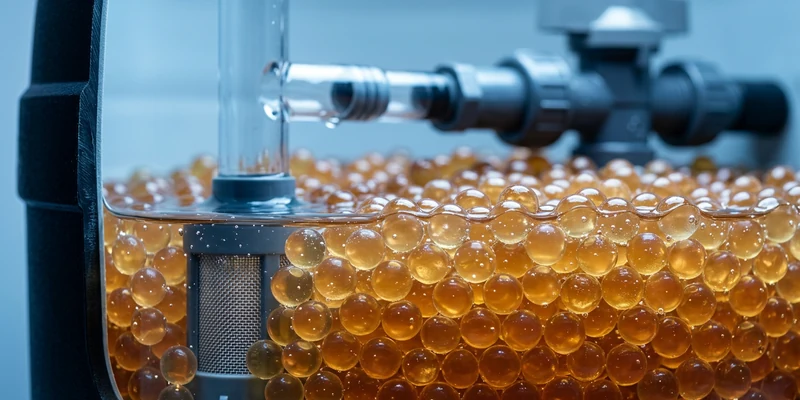
- Water passes through a tank filled with water softener resin, tiny beads coated with sodium or potassium ions.
- Calcium and magnesium in the water swap places with those ions through ion exchange, leaving the water measurably softer as it exits the tank.
- Once the resin’s capacity is used up, the system runs a regeneration cycle, flushing the resin with a salt brine solution to recharge it for the next round.
The Main Parts of a Water Softener
Every conventional salt-based softener is built around the same basic components, even though grain capacity, control head features, and cabinet styles vary by manufacturer. Learning these parts first makes the rest of the process, and any future troubleshooting, much easier to follow.
| Component | What it does |
|---|---|
| Mineral tank | Holds the water softener resin beads where ion exchange happens |
| Resin | Tiny beads coated with sodium or potassium ions that swap out calcium and magnesium |
| Brine tank | Holds salt or potassium chloride dissolved into brine for regeneration |
| Control valve/head | Tracks water use or time and triggers regeneration on the manufacturer’s schedule |
| Drain line | Carries used brine and rinse water away during regeneration |
| Bypass valve | Lets water skip the softener entirely for maintenance or resin changes |
Ion Exchange, Step by Step
As hard water enters the mineral tank, it flows down through the resin bed. Calcium and magnesium ions in the water are attracted to the resin beads more strongly than the sodium or potassium ions currently sitting on them, so a swap happens: the hardness minerals attach to the resin, and sodium or potassium is released into the water instead. The water leaving the tank has measurably less calcium and magnesium than the water that entered it.
This is a physical and chemical exchange, not a filtration process, which is an important distinction. Softening does not remove particles or strain anything out of the water the way a sediment or carbon filter does; it swaps one set of dissolved minerals for another.
The Regeneration Cycle
Resin has a finite capacity. Once enough calcium and magnesium have attached to the beads, the resin needs to be recharged before it can keep softening effectively. This water softener regeneration process is what recharges the system: the control valve draws concentrated brine from the salt tank through the resin bed, which reverses the exchange, so the built-up hardness minerals are flushed out to the drain, and sodium or potassium ions are restored to the resin.
Control heads generally work one of two ways. Metered heads track actual water use and trigger regeneration based on how much softening capacity has actually been used, while timed heads regenerate on a fixed schedule regardless of use. Follow your unit’s manual for the specific regeneration frequency and salt dosage it is designed around rather than assuming a generic number, since this varies by resin volume, hardness level, and household water use.
What a Softener Does Not Do
A softener treats hardness and, when rated for it, some level of iron. It does not disinfect water, and it is not designed to remove bacteria, nitrate, lead, PFAS, or other regulated contaminants. Households that need those addressed require a separate treatment step, such as a whole house water filter or a dedicated system matched to the specific contaminant found on a lab test.
It also does not remove sediment or turbidity on its own. A softener that constantly clogs or seems to lose capacity faster than expected is often dealing with sediment or particulate matter the resin was never meant to filter, which points back to needing a sediment stage ahead of the softener rather than a bigger or different softening unit.
It is also worth knowing that ion exchange adds a small amount of sodium to the water as part of the trade-off, since sodium replaces the hardness minerals that are removed. If you are on a sodium-restricted diet or have specific health concerns about that, talk to your doctor, and consider leaving a cold tap unsoftened for drinking or adding a dedicated reverse osmosis system for drinking water instead.
Softening and Iron on Well Water
Well water often carries iron alongside hardness, and that combination changes how a softener performs over time. Standard resin is built to exchange calcium and magnesium efficiently, but iron can coat the resin beads, a process sometimes called iron fouling, which reduces how well the resin exchanges ions even when regeneration is running on schedule. This is a separate issue from hardness itself and needs its own attention.
If your well water testing shows iron alongside hardness, look specifically for a softener rated for iron reduction rather than a plain hardness-only unit, and expect resin cleaning to be part of your maintenance routine more often than a household with hardness alone. Our guide to removing iron from well water covers how iron behaves separately from hardness and what treatment options address it directly.
Common Mistakes to Avoid
- Confusing softening with filtration. Ion exchange swaps minerals, it does not strain out sediment, bacteria, or chemical contaminants.
- Assuming a softener handles every well water problem. Iron beyond what the unit is rated for, bacteria, and other contaminants need their own treatment.
- Ignoring the sodium trade-off. Softened water carries added sodium, which matters for households on a restricted diet.
- Skipping the manufacturer’s regeneration guidance. Frequency and salt dosage are specific to your resin volume and hardness level, not a universal number.
- Forgetting the bypass valve exists. It is the simplest way to service the unit or test unsoftened water without disconnecting anything.
Frequently Asked Questions
How does a water softener work in simple terms? It swaps calcium and magnesium in your water for sodium or potassium as the water passes through a bed of resin, a process called ion exchange, then periodically recharges that resin with a salt brine flush.
Does a water softener remove all minerals from water? No. It specifically targets hardness minerals, calcium and magnesium, and some units also handle a limited amount of iron. It does not remove other dissolved solids or contaminants.
Why does a softener need salt to work? Salt, dissolved into brine, is what recharges the resin during regeneration, restoring the sodium or potassium ions the resin needs to keep exchanging with hardness minerals.
Does softened water taste salty? Most people do not notice a salty taste, since the sodium added through ion exchange is present in relatively small amounts compared to table salt levels, though the exact amount depends on your water’s original hardness.
Can a water softener remove bacteria or other contaminants? No. It is built for hardness, not disinfection. Bacteria, nitrate, lead, and similar concerns require separate testing and treatment, ideally guided by a certified laboratory result.
How long does resin last before it needs replacing? Resin has a working life measured in years, but the exact figure depends on your water conditions and the manufacturer’s design. Check your unit’s manual rather than assuming a fixed number.
The Bottom Line
A water softener works through ion exchange, swapping calcium and magnesium for sodium or potassium as water passes through resin, then recharging that resin with a salt brine flush once its capacity is used up. It is a mineral-swapping process, not filtration, so it does not address bacteria, nitrate, lead, or other contaminants on its own. Understanding that distinction helps set the right expectations before you decide what kind of system your household actually needs.