Last updated: August 16, 2026
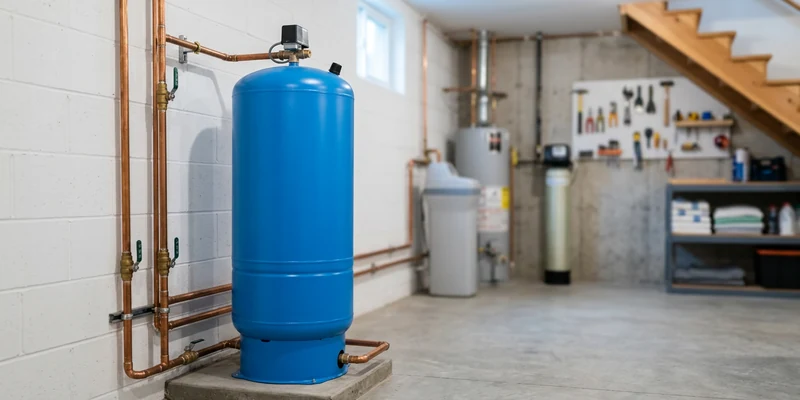
A well pressure tank is easy to overlook because it does not do anything visible, no lights, no display, usually tucked into a basement corner or a utility closet. But it is the reason your pump is not starting every single time you turn on a faucet, and understanding what does a well pressure tank do makes a lot of well system behavior easier to interpret.
This guide covers how a well pressure tank works, what its air bladder actually does, why well pressure tank size matters, and the signs that a tank is no longer doing its job. Diagnosing a tank problem is something most well owners can learn to recognize; adjusting or replacing one is better left to a licensed well or pump professional, since it involves depressurizing a system that supplies your household’s drinking water.
Quick Answer
What does a well pressure tank do?
- It stores a reserve of water under pressure so the pump is not switching on and off with every use of a faucet or appliance.
- Inside, an air bladder or diaphragm keeps a cushion of compressed air pressing against the stored water, which is what actually pushes water out to the house between pump cycles.
- When that air charge is lost, the tank is described as waterlogged, and the pump typically starts cycling far more often than normal, which shortens its working life.
Well Pressure Tank Basics at a Glance
The table below summarizes the core ideas behind how a well pressure tank works before the sections that follow go into more detail.
| Concept | What it means | Why it matters |
|---|---|---|
| Air bladder or diaphragm | Separates compressed air from stored water inside the tank | This is what pushes water to the house between pump cycles |
| Air precharge | The air pressure set inside the empty tank before it is filled | Set relative to the pressure switch’s cut-in point, not a random number |
| Drawdown | The usable volume of water the tank delivers per pump cycle | Determines how often the pump starts for typical household use |
| Well pressure tank size | Tanks range widely, from a few gallons to well over 40 gallons | Larger tanks generally mean fewer, longer pump cycles |
| Waterlogged tank | A tank that has lost its air charge and is mostly full of water | Leads to frequent pump cycling and reduced tank life |
How the Air Bladder Actually Works
Most modern well pressure tanks use an internal rubber bladder or diaphragm that physically separates a pocket of compressed air from the water the pump delivers. As the pump fills the tank, water pushes against the bladder, compressing the air pocket further. That compressed air is what forces water back out through the plumbing whenever a faucet opens, without the pump needing to run continuously.
This is also why a well pressure tank is not just a holding container, it is doing mechanical work. If the bladder develops a leak or the air charge slowly bleeds off over time, the tank stops functioning as a buffer and the system starts leaning on the pump for nearly every drop of water used.
Air Precharge and Why It Is Set the Way It Is
Before a well pressure tank is put into service, its air side is precharged to a specific pressure, and that number is set in relation to the pressure switch’s cut-in point rather than picked at random. Extension and manufacturer guidance generally describes setting the precharge a few pounds per square inch below the switch’s cut-in setting, with the exact gap depending on the specific switch range in use.
Getting that relationship wrong in either direction causes problems: too little air and the tank waterlogs quickly, too much and the switch may not behave predictably. This is one of the more common reasons well owners bring in a professional rather than adjusting it themselves, since it typically means depressurizing the tank first. Our guide to well pressure switch settings covers how the switch side of that relationship works.
Well Pressure Tank Size and Drawdown
Well pressure tank size is usually described by total volume, but the number that actually matters day to day is drawdown, the amount of water the tank can deliver before the pump needs to restart. A larger tank generally means longer stretches between pump cycles, which many well owners and pump manufacturers consider easier on the pump over time.
Sizing a tank involves the pump’s flow rate, the household’s typical demand, and the pressure switch range together, not the tank alone. If you are choosing a tank as part of a new pump setup, our well pump buying guide covers how tank and pump pairing usually gets approached.

Signs a Well Pressure Tank Is Waterlogged or Failing
A waterlogged pressure tank has lost most or all of its air cushion, which means the pump ends up doing the work the tank was supposed to handle. The most common sign is a pump that starts and stops far more frequently than it used to, sometimes within seconds of a faucet opening and closing. Pressure that swings noticeably during normal use, a tank that feels heavier or sounds like it is mostly full of water when tapped, and visible rust or corrosion on an older steel tank are also worth noting.
None of these signs alone confirms a failed bladder, since a misadjusted pressure switch can produce similar symptoms. That overlap is exactly why a licensed well or pump professional checking both the tank and the switch together tends to get to the real cause faster than guessing at one part.
Common Mistakes to Avoid
- Assuming a waterlogged tank means a new pump is needed. Tank and pump problems produce similar symptoms but usually have separate fixes.
- Guessing at precharge pressure. It needs to be set relative to the pressure switch, not to an arbitrary round number.
- Ignoring an undersized tank. A tank that is too small for the pump’s flow rate causes excessive cycling even when everything else is working correctly.
- Checking air pressure while the tank is still pressurized. Precharge is meant to be checked and adjusted on a tank that has been properly depressurized, which is safer left to a professional.
- Overlooking corrosion on older steel tanks. Rust and pitting are a sign a tank may be nearing the end of its service life.
Frequently Asked Questions
What does a well pressure tank do? It stores water under pressure using a compressed air cushion, so the pump does not need to start every time a faucet is used.
What well pressure tank size do I need? Sizing depends on the pump’s flow rate and household demand together, not the tank alone; a licensed well or pump professional can match tank size to your specific setup.
How do I know if my pressure tank is waterlogged? The clearest sign is a pump cycling much more often than usual, sometimes within seconds, along with noticeable swings in water pressure.
Can I adjust the air pressure in my well pressure tank myself? It is a straightforward concept but involves depressurizing the tank correctly first, which is why many well owners have a professional handle it rather than risk an incorrect adjustment.
How long do well pressure tanks typically last? Service life varies by tank type, water conditions, and how well it is matched to the pump; follow manufacturer guidance for your specific model and watch for the waterlogging signs described above.
Is a waterlogged tank the same thing as short cycling? A waterlogged tank is one of the more common causes of short cycling, but not the only one; our short cycling guide covers the other possibilities.
The Bottom Line
A well pressure tank stores water under pressure using an internal air bladder, which is what keeps a pump from starting every time a faucet is used. Well pressure tank size and air precharge both need to be matched to the pump and pressure switch, not chosen at random, and a waterlogged tank is one of the most common reasons a pump starts cycling too often. Recognizing the signs is something any well owner can do; adjusting or replacing the tank is a job for a licensed well or pump professional.