Last updated: August 16, 2026
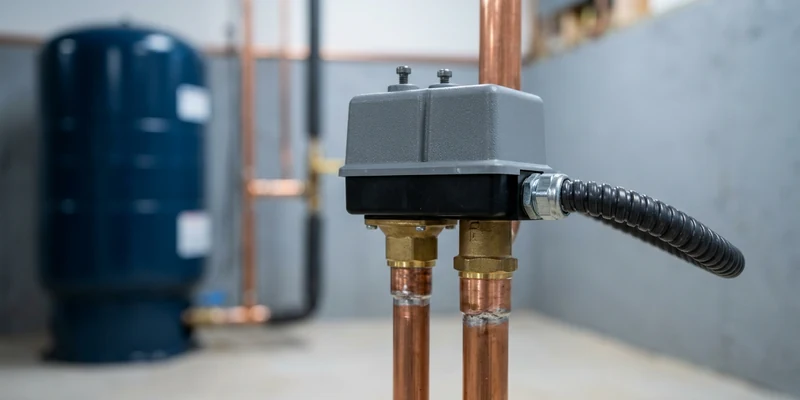
Well pressure switch settings, sometimes searched as pressure switch settings for well pump, are usually written as two numbers separated by a slash, like 30/50, and most well owners encounter them for the first time while trying to figure out why their water pressure feels off. Those numbers describe exactly when the pump turns on and when it turns off, which makes the switch one of the more influential, and more misunderstood, parts of a well system.
This guide explains what cut-in and cut-out pressure actually mean, the settings that show up most often on residential systems, and how the switch relates to the pressure tank next to it. Reading a switch and understanding what it is doing is something any well owner can learn; physically adjusting it involves an energized electrical component next to your water supply, which is squarely a job for a licensed well or pump professional.
Quick Answer
What do well pressure switch settings actually mean?
- The first number is cut-in pressure, the point where the switch turns the pump on; the second is cut-out pressure, where it turns the pump off.
- Residential systems commonly use 20/40, 30/50, or 40/60 psi, with the choice depending on the home’s plumbing, elevation, and pump.
- A consistent gap between the two numbers, often around 20 psi, is part of how the switch avoids cycling the pump too often.
Common Well Pressure Switch Settings at a Glance
These are the ranges that show up most often in residential well pressure switch settings, treat them as commonly used examples rather than a recommendation for your specific system.
| Setting | Cut-in / cut-out | Typically used for |
|---|---|---|
| 20/40 | Pump on at 20 psi, off at 40 psi | Smaller homes or systems with shorter pipe runs |
| 30/50 | Pump on at 30 psi, off at 50 psi | Common default for many single-story homes |
| 40/60 | Pump on at 40 psi, off at 60 psi | Multi-story homes, longer pipe runs, or irrigation demand |
The gap between cut-in and cut-out, often around 20 psi on these common ranges, works together with the well pressure tank to control how often the pump starts. Our pressure tank guide covers that relationship in more depth.
Cut-In and Cut-Out, Explained Simply
Cut-in pressure is the low point. When tank pressure drops to that number, typically because water has been used and the tank’s reserve has drawn down, the switch closes a contact and starts the pump. Cut-out pressure is the high point. Once the tank refills to that pressure, the switch opens the contact and stops the pump.
Between those two points, the pressure tank is supplying water on its own, without the pump running at all. That is the entire point of pairing a switch with a tank: the switch decides when the pump needs to work, and the tank absorbs everything in between.
Why the Gap Between Cut-In and Cut-Out Matters
The difference between the two numbers is called the differential, and it is not arbitrary. Too narrow a gap means the pump starts and stops more often than necessary, which is part of what short cycling looks like. Too wide a gap can mean pressure swings that are noticeable at the tap, especially in the shower.
Most factory-set switches use a differential in the neighborhood of 20 psi, which is why 20/40, 30/50, and 40/60 all share that same spacing. This differential also needs to line up with how the pressure tank’s air side is set, which is why a switch and tank are really best thought of as a matched pair rather than two independent parts. See our short cycling guide if your pump seems to be starting and stopping unusually often.

Choosing a Setting: What Actually Drives the Decision
Higher cut-in and cut-out settings generally suit homes with more stories, longer horizontal pipe runs, or higher elevation points that need extra pressure to reach comfortably, along with households running irrigation or other higher-demand fixtures. Lower settings are often enough for smaller, single-story homes with shorter runs.
Every pump also has a maximum pressure it is rated to work against, so a setting is not just a comfort preference, it needs to stay within what the specific pump and plumbing can handle safely. That is one of the main reasons well pressure switch settings are chosen and adjusted by a licensed well or pump professional rather than picked from a general chart alone.
Signs a Pressure Switch May Be Misadjusted or Failing
A pump that starts noticeably later or earlier than expected, pressure that feels consistently low or high compared to what the household is used to, or a pump that will not start or will not stop at all are the main signs worth paying attention to. A switch can also fail electrically, in which case it may not respond to pressure changes at all.
Because a misadjusted switch, a waterlogged tank, and a struggling pump can all produce overlapping symptoms, confirming which one is actually at fault is usually faster and safer with a licensed well or pump professional than by trial and error.
Reading Your Current Settings Without Adjusting Anything
You do not need to touch the switch to learn something useful about it. Most systems have a pressure gauge mounted near the tank, and simply watching it during normal use tells you a lot: note the psi reading right as the pump kicks on, then note it again right as the pump shuts off. Those two numbers are your system’s actual cut-in and cut-out pressure, whether or not they match the sticker on the switch itself.
Comparing what you observe against the common 20/40, 30/50, or 40/60 ranges can hint at whether your well pressure switch settings are still working as intended, or whether they have drifted from where they were originally set. A gauge reading that seems inconsistent from cycle to cycle, rather than a steady, repeatable pattern, is worth mentioning to a licensed well or pump professional, since it can be an early sign of a switch or tank issue before it becomes a bigger problem.
Common Mistakes to Avoid
- Adjusting the switch without checking the pump’s rated pressure. A setting that exceeds what the pump or plumbing can handle can cause damage.
- Ignoring the tank’s air precharge when changing switch settings. The two are meant to be set together, not independently.
- Treating a wide differential as normal. A gap much larger than the common 20 psi range is often a sign something needs attention.
- Working on the switch while the system is energized. This is an electrical component sitting directly on a pressurized water line.
- Assuming low pressure is always a switch problem. Clogged filters, pipe scale, or the well itself can also be the cause.
Frequently Asked Questions
What do well pressure switch settings like 30/50 mean? The first number is cut-in pressure, where the pump turns on, and the second is cut-out pressure, where it turns off.
What is a normal pressure switch setting for a well pump? 20/40, 30/50, and 40/60 psi are the ranges most commonly used on residential systems, chosen based on the home’s plumbing and elevation.
Can I change my own well pressure switch settings? It involves an energized electrical component connected to your pressurized water supply, so most well owners have a licensed well or pump professional make the adjustment.
Why does the gap between cut-in and cut-out matter? That differential, often around 20 psi, helps control how often the pump starts; too narrow a gap can contribute to short cycling.
Does the pressure switch need to match the pressure tank? Yes. The tank’s air precharge is set relative to the switch’s cut-in pressure, so the two work as a matched pair rather than independently.
What happens if my well pressure switch settings are too high for my pump? Exceeding the pump’s rated pressure can strain the motor and plumbing; a licensed well or pump professional can confirm the safe range for your specific equipment.
The Bottom Line
Well pressure switch settings like 20/40, 30/50, and 40/60 describe the cut-in and cut-out points that decide when your pump starts and stops. The gap between those numbers, along with the tank’s air precharge, shapes how often the pump cycles and how consistent your household pressure feels. Understanding the numbers is useful for any well owner, but changing them safely is a task for a licensed well or pump professional.