Last updated: August 16, 2026
A water softener bypass valve is one of those small fittings that homeowners rarely think about until the moment they actually need it, usually while standing next to a leaking control head wondering how to stop water flowing into a unit that clearly needs to come apart. Every properly installed softener has one, and knowing how it works before that moment arrives saves a lot of standing around.
This guide covers what a bypass valve actually does, the different styles you will run into, and the situations where switching to bypass mode is the right call, along with the ones where it is only a short-term workaround. Searches for how to bypass a water softener tend to spike right when a leak or repair comes up unexpectedly, so it helps to know the steps before that moment arrives.
Quick Answer
What does a water softener bypass valve do?
- It reroutes water around the softener so the rest of the house keeps running on untreated water while the unit is serviced, repaired, or simply switched off.
- Use it for maintenance, resin changes, watering the lawn, or when a leak needs to be stopped fast.
- Bypassed water is not softened, so it should be treated as a short-term state rather than a permanent setting.
What a Bypass Valve Actually Does
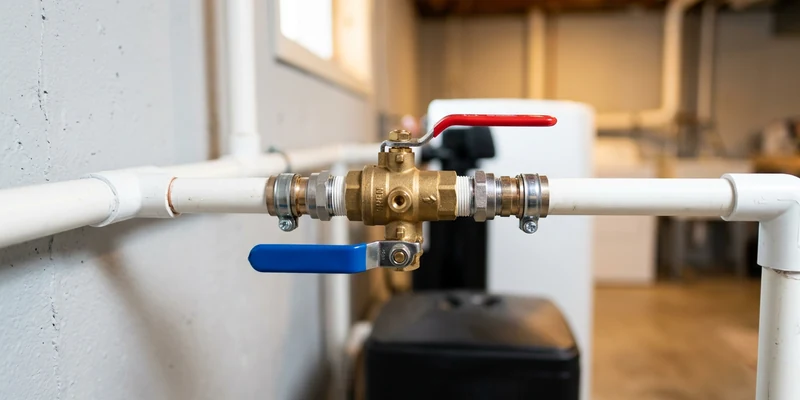
A bypass valve sits at the point where your main water line connects to the softener. In its normal position, water flows into the unit, through the resin tank, and back out into the house as softened water. Switch it to bypass, and the valve redirects incoming water straight past the softener, so it reaches your fixtures untreated but the water never stops flowing.
| Valve style | How it works | What to know |
|---|---|---|
| Single lever or dial | One control rotates to redirect flow | Most common on newer residential softeners, quick to operate |
| Push-button | A button presses in to engage bypass | Common on some cabinet-style and compact units |
| Three-valve manual setup | Separate inlet, outlet, and bypass valves | Found on older installs, requires closing two valves and opening a third in sequence |
If you are not sure which style your softener has, the control head or the installation manual will usually show it, and it is worth locating and testing yours before you actually need it in an emergency.
When Bypass Mode Makes Sense
Routine maintenance is the most common reason to switch to bypass. Anytime you are cleaning the resin tank, checking the injector, or disconnecting a line for a repair, bypass keeps the household supplied with water while you work, rather than shutting off the whole house at the main.
Watering the lawn or filling a pool are also reasonable times to use it, since there is little benefit to softening water that is going straight into the ground. Some households leave the softener bypassed seasonally for outdoor use and switch back once irrigation season ends.
When It Is an Emergency Response, Not a Setting to Leave On
A visible leak at the control head or standing water around the unit is the other common trigger, and in that situation bypass is a fast way to stop water moving through the softener without shutting off the entire house. It buys time to assess the problem or wait for a technician without living without water in the meantime.
That said, water left in bypass indefinitely is untreated water, meaning hardness minerals are reaching your whole house again. If a repair is going to take more than a few days, it is worth treating bypass as a temporary state and following up rather than letting it become the new normal.
Bypass Valves and the Rest of Your Plumbing
The bypass valve is only one piece of a larger installation, and its placement relative to your other equipment matters. Our guide to water softener installation covers how the bypass, sediment filter, softener, and water heater fit together as a sequence, plus how to decide between installing it yourself and calling a licensed plumber.

Testing Your Bypass Valve Before You Need It
A bypass valve that has not moved since installation can seize up or feel stuck the first time you actually try to use it, usually at the least convenient moment. Cycling it into bypass and back into normal service once or twice a year, even when nothing is wrong, keeps the mechanism working smoothly and gives you a chance to confirm you know how it operates before an actual leak or repair forces the issue.
While you have it in bypass, it is also a reasonable time to peek at the connections around the valve for any early signs of corrosion or mineral buildup, since that area sees constant water flow and is one of the more common places a small leak starts. Folding this check into your regular upkeep routine, alongside checking salt levels and other basics covered in our maintenance schedule guide, means it never gets forgotten entirely.
Bypass Valves on Older or Non-Standard Systems
Not every household has a modern single-lever bypass valve. Older three-valve setups are still common in homes where the softener has not been replaced in many years, and some specialty or commercial-style units use a configuration that does not match the typical residential diagram at all. If you inherited a system with an unfamiliar valve arrangement, it is worth tracing the water flow by hand, in normal operation, so you understand which valve does what before you need to change anything under pressure.
If the valve itself looks worn, corroded, or does not hold its position reliably, replacing just the bypass assembly is usually far simpler than replacing the whole softener, and it is a reasonable upgrade to make even on an otherwise functional older unit.
Common Mistakes to Avoid
- Not knowing where the bypass valve is until you need it. Find and test it once during calm conditions, not during a leak.
- Leaving the system in bypass long-term. Untreated water reaches the whole house until you switch back.
- Forcing a lever-style valve past its stop. These valves are designed to turn a specific distance; forcing it can damage the seal.
- Assuming bypass fixes the underlying problem. It stops water from flowing through a faulty unit, it does not repair it.
- Confusing bypass with the main shutoff. Bypass reroutes water around the softener only; it does not stop water to the house.
Frequently Asked Questions
How do I bypass my water softener? The exact steps depend on your valve style. A single lever or dial usually turns fully in one direction to engage bypass and back to return to normal service, while older three-valve setups require closing the inlet and outlet valves and opening the center bypass valve in sequence.
Can I leave my water softener in bypass mode permanently? You can, but the water reaching your home will not be softened. Occasional or seasonal bypass for irrigation is common, but for household use it is better treated as a temporary state during maintenance or repair.
Does bypassing a water softener stop water flow completely? No. Bypass reroutes water around the softener so it still reaches your fixtures, just untreated. To stop water flow entirely you need the main shutoff valve, not the bypass.
Why is my water still hard after I switched off bypass? Give the system a few minutes to fully cycle back into service, and check that the valve reached its normal-service position rather than stopping partway. If hardness persists, the softener itself may need service.
Do all water softeners have a bypass valve? Properly installed residential softeners should include one, since it is the standard way to service the unit without shutting off the house. If yours does not have one, it is worth having an installer add it.
Should I bypass my softener when watering the lawn? Many households do, since there is little reason to soften water used outdoors and it reduces salt and water use during the regeneration cycle.
The Bottom Line
A bypass valve reroutes water around your softener so the household keeps running while the unit is serviced, repaired, or simply not needed for a task like watering the lawn. Learn where yours is and how it operates before an emergency forces you to figure it out, and treat bypass mode as a temporary state rather than a long-term setting, since bypassed water is untreated water.