Last updated: August 16, 2026
Once you suspect hard water, the next step is putting an actual number on it. Every water hardness scale works the same way underneath, it measures how much dissolved calcium and magnesium is in the water, but the units and the labels attached to those units trip people up more often than the concept itself.
This guide covers how a hard water test actually works, how to read grains per gallon against milligrams per liter, and what your number should and should not be used for once you have it.
Quick Answer
How do you measure water hardness?
- A hard water test, either a home strip or a lab result, measures dissolved calcium and magnesium in grains per gallon (GPG) or milligrams per liter (mg/L, the same as parts per million).
- One grain per gallon equals about 17.1 mg/L, so the two units convert directly once you know the formula.
- The commonly used water hardness scale runs from soft to very hard: roughly 0 to 3.5 GPG is soft, 3.5 to 7 is moderately hard, 7 to 10.5 is hard, and above 10.5 GPG is very hard.
Water Hardness Scale at a Glance
This is the scale most commonly referenced by extension services and water treatment guidance in the United States, expressed in grains per gallon with the milligrams per liter equivalent alongside it.
| Grains per gallon (GPG) | Milligrams per liter (mg/L) | Classification |
|---|---|---|
| 0 to 3.5 | 0 to about 60 | Soft |
| 3.5 to 7 | About 60 to 120 | Moderately hard |
| 7 to 10.5 | About 120 to 180 | Hard |
| Above 10.5 | Above about 180 | Very hard |
Where Hardness Comes From in the First Place
Water hardness is not something that appears at random, it is picked up as groundwater moves through soil and rock on its way into an aquifer. As water passes through limestone, dolomite, and other calcium-rich and magnesium-rich mineral deposits, small amounts of those minerals dissolve into it. The longer and deeper that path, the more mineral content the water tends to carry by the time it reaches a well.
This is also why hardness varies so much by region and even by neighborhood. A well drawing from a limestone-heavy aquifer can test very hard, while a well only a short distance away, drawing from different geology, can test moderately hard or soft. There is no way to predict your number from a neighbor’s result or a regional reputation for hard water, which is exactly why a direct hard water test on your own well matters more than general assumptions.
Grains Per Gallon vs Milligrams Per Liter
Grains per gallon is the unit most commonly used by water softener manufacturers in the United States, while milligrams per liter, which is functionally the same as parts per million, is more common on lab reports and in scientific contexts. The conversion is straightforward: one grain per gallon equals approximately 17.1 mg/L, so a lab result reported in mg/L can be converted to GPG by dividing by 17.1.
Knowing both units matters because a softener sizing chart will usually ask for your hardness in grains per gallon, while a full lab water hardness test often reports in mg/L. Mixing up the two can lead to sizing a system for the wrong hardness level entirely.
Home Test Strips vs Lab Testing
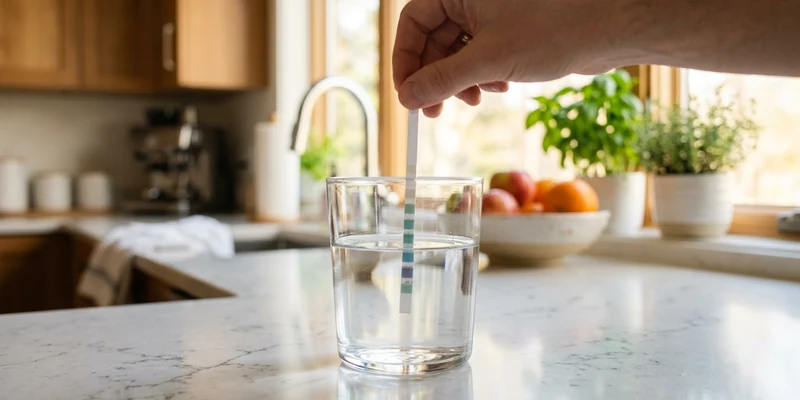
Hardness is one of the few well water tests where an inexpensive home strip gives you a genuinely useful answer on its own. Because hardness is a nuisance and plumbing issue rather than a regulated health contaminant, a reasonably accurate strip reading is generally good enough to decide whether treatment is worth considering and roughly how hard your water is.
That is different from health-sensitive parameters like bacteria, nitrate, lead, or PFAS, where a strip is only useful for rough screening and a certified laboratory result is what actually confirms the finding. Our water test kit guide covers the difference between a basic hardness strip and a full lab panel in more detail.
Why the EPA Doesn’t Set a Hardness Limit
Hardness falls under the EPA’s secondary drinking water standards, a set of non-enforceable guidelines that address taste, odor, and appearance rather than health and safety. Because of that, there is no federal maximum for hardness the way there is for regulated contaminants like lead or nitrate, and no lab or agency will flag a high hardness result as a violation.
Some states or local water utilities choose to adopt hardness guidance informally, but for a private well, the decision to treat hardness comes down entirely to how much the scale, soap performance, and appliance wear are bothering your household, not a regulatory requirement.
Using Your Number to Size Treatment
Once you have a real GPG number, it becomes the starting point for any softener decision rather than a guess based on symptoms. Softener sizing charts are built around household size and hardness level together, so the same hardness number can call for a very different system size in a two-person household than in a family of six.
It is also worth retesting periodically rather than assuming your original number holds forever. Well water hardness can shift gradually as groundwater conditions change, and a number from several years ago may no longer match what is actually coming out of the tap today.
If your test also flags iron or another mineral alongside hardness, that changes the equipment recommendation too, since standard softening resin is not built to handle iron well. Our guide to how a water softener works covers how resin and regeneration respond to your hardness number once you have it.
Common Mistakes to Avoid
- Mixing up GPG and mg/L without converting. A sizing chart built for grains per gallon will give the wrong answer if you plug in a milligrams per liter number directly.
- Assuming a high hardness number is a safety issue. It is a nuisance and appliance concern under EPA’s secondary standards, not a regulated contaminant.
- Relying on a strip for health-sensitive contaminants. Strips work well for hardness but are not a substitute for a certified lab on bacteria, nitrate, lead, or PFAS.
- Sizing a softener off a guess instead of a test. Undersized systems regenerate constantly, oversized ones waste salt and water.
- Ignoring other results on the same test. Iron or manganese alongside hardness changes what kind of system you should be shopping for.
Frequently Asked Questions
What is a good water hardness scale reading? Below 3.5 grains per gallon is considered soft, while readings above 10.5 GPG are considered very hard. There is no official safety threshold since hardness is not a regulated contaminant.
How accurate is a hard water test strip? Strips give a reasonably useful ballpark reading for hardness specifically, which is one of the few well water parameters where a home strip is considered adequate on its own.
How do I convert grains per gallon to mg/L? Multiply grains per gallon by approximately 17.1 to get milligrams per liter. To go the other direction, divide the mg/L figure by 17.1.
Does the EPA regulate water hardness? No. Hardness is listed under the EPA’s secondary drinking water standards, which are non-enforceable guidelines about taste and appearance rather than health-based limits.
Can I test water hardness myself? Yes. A home hardness test strip or a basic titration kit is generally sufficient for this specific parameter, unlike health-sensitive contaminants that call for certified lab testing.
Why does my softener sizing chart ask for grains per gallon? Grain capacity, the standard way softeners are rated, is measured against grains per gallon of hardness removed, so manufacturers size their charts around that unit.
The Bottom Line
Measuring water hardness comes down to reading a number in grains per gallon or milligrams per liter and placing it on the standard scale, from soft below 3.5 GPG to very hard above 10.5 GPG. Hardness is not a regulated health contaminant, so a home strip is generally good enough to get your number, and that number should drive any softener sizing decision rather than guessing from visible signs alone.